Is there a church without dogma?
On the Evolutionary Church and prayer as intimate communion, in the words of Dr. Marc Gafni
The passages from Dr. Marc Gafni in this post come from his oral essays in the Great Library: lightly edited transcripts of his live weekly teachings, now called Sensemaking in a Time Between Worlds. The style is spoken word, not a formal essay.
Is there a church without dogma? Yes. Dr. Marc Gafni calls it an Evolutionary Church. He and Barbara Marx Hubbard began it in 2017 as the weekly broadcast called Evolutionary Church, which evolved into One Mountain, Many Paths and is now called Sensemaking in a Time Between Worlds. In his words: "We want to create together a religion beyond religion—a synagogue beyond synagogues, a secular humanist center beyond secular humanist centers, a Church beyond churches."
What is an evolutionary church?
It was our deepest intention, to have an Evolutionary Church—which was God's dream.
Reality's intention is the Evolution of Love. The Evolution of Love is the most glorious thing you can possibly imagine. We want to create together a religion beyond religion—a synagogue beyond synagogues, a secular humanist center beyond secular humanist centers, a Church beyond churches. We don't want to make this a narrow, liberal, New Age movement where we're just talking to each other. We don't want to do that.
This is kind of shocking: Seventy percent of the entire world lives in a great tradition, in connection to a religion. So if we want to heal the fractured planet, if we want to heal a fragmented world, we can't just talk to our own internet bubble. We can't talk to our own narrow Facebook group, where we only get our own sense of the world reflected back to us.
We need to embrace all of Reality. We have to "have the whole world in our hands." Seventy percent of the whole world lives in deep connection to a religion, so we don't get rid of it. We have to up-level religion; we have to evolve religion. Just like medicine evolved—you won't go to a fifteenth-century doctor, so we don't want to be doing fifteenth-century religion. We have to participate in the evolution of religion and of Spirit, because Spirit is actually evolving; it's becoming. There's more God to come.
- Democracies are an evolution of Spirit.
- Human rights are an evolution of Spirit—for every human being is an evolution of Spirit.
- The emergence of the feminine is an evolution of Spirit.
- Technologies, with their new intimate interconnections, are evolutions of Spirit.
We want to reclaim Love as religion. We want to realize that all the great traditions share a core set of truths, and we want to articulate those truths. Then we want to participate in bringing all the sciences to bear, to realize that those truths are evolving. Finally, we want to realize that we participate in their evolution.
Why did religion become dogma?
Let's reclaim Gloria in this new moment as the divinely inspired Evolutionary Impulse, awake in us, as us, and through us. Gloria.
The core religious impulse is this human understanding—which is the Divinity that lives inside of us—which understands and feels Gloria.
- We understand that life matters.
- We understand that life is meaningful.
- We understand that it matters which choices we make.
This understanding—that life matters, that I am wildly significant, that my drive to survive is but an expression of self-love, that ultimately my life matters so immensely, I'm needed by All-That-Is, that the love that moves through me is the most real thing in the world and I'm willing to stake my life on it—is the religious impulse. And what we need to do is to correct the mistakes that the religious impulse historically made.
The religious impulse ran into dogma, just as science, as it took power, has adopted the dogma which we call dogmatic materialism, which has nothing to do with science.
Religion ran into dogma. Religion sought to draw down the voice of Divinity and make it widely available—and yet such consciousness from the past couple thousand years was profoundly ethnocentric. We thought that God spoke only to us. We weren't connected to other parts of the world. We thought that in order to be inside the circle, to feel genuine Eros, we had to be the chosen one and other people were outside the circle.
That was the tragedy not just of religion. It was also the tragedy of communism, which split into factions. It's the tragedy of us/them: we're inside, and you're outside. We're breaking through that tragedy. We're breaking through the ethnocentric religion in which we're chosen. We're removing the boundary.
We're entering into no boundary religion, into no boundary consciousness.
Isn't "spiritual but not religious" enough?
We describe three levels of religion.
A world religion requires prayer. You can't have a real religion without prayer. However, prayer is not going to mean what it meant at level-one religion. Let's say level one is premodernity, the traditional period up to the Renaissance.
Then level two is "no religion"—modernity. Now there's a lot of ways to say "no religion". For example, in the United States in the last thirty years, the most common self-identification for the younger generation is "spiritual but not religious." That's a version of no religion. We're going to talk about why that's insufficient. It's too wishy-washy. It's non-binding. There's no sense of obligation. There's no sense of intrinsic value. It doesn't take you home. That's level two: no religion, spiritual but not religious.
I may pray for my own businesses to be successful. But I'm living in a global world where I'm affected by everything. I'm actually parasitizing off the world in my little spiritual-but-not-religious bubble—I'm not actually a citizen of the world. …
We live in a world in which the entire world is interconnected today, but I'm actually not part of that interconnection in any real way. I'm not part of the Unique Self Symphony that's part of the healing of Reality.
So what would a religion without dogma be?
Level one was religion, level two was no religion. Level three:
Religion, no religion, religion. Level three has to be religion again.
But level three can't be level-one religion—it can't be dogmatic religion, it can't be religion hijacked for power, it can't be ethnocentric. It can't be any of the things that the old religion was, and it's got to be something new. It has to transcend and include the best insights of premodernity (the old religion) and of the modernity that rejected religion. Those two sets of insights need to be integrated. We negate—as Hegel said—all the bad stuff, while we preserve all the good stuff, as we create something new.
That's the new religion.
Do I have to leave my own tradition?
We have to be committed—and to be committed means we have to speak to the whole world. We're trying to evolve the source code of consciousness and culture, so we have to re-engage the religious impulse.
We have to be able to feel this new Story [of Value] that we're telling and realize that it resonates with our own traditions. And if you're post-traditional, you have to feel that this is a new Story of human progress. You've got to feel that this is the new identity of Homo sapiens, who are fulfilled as Homo amor.
This realization of Homo amor is the realization of all the great traditions. It's post-traditional, and it raises all the traditions.
My gentle, humble suggestion to everyone is, if you can, find a great tradition to practice in and participate in the evolution of that great tradition. And at the same time be a dual citizen of Homo amor, of CosmoErotic Humanism, of world spirituality, of this great new Story that we're telling. We need both. We need the great traditions, and we need a new Story with new languages and new rituals and new practices.
You can be a Jew, you can be a Protestant, you can be a Catholic, you can be an indigenous person, you can be an Aboriginal, you can be an atheist, you can be a secular humanist. We're feeling together the truth of Homo amor, and we're creating a new Story in which that what unites us is so much greater than that which divides us.
What if I don't believe in God?
I want to do a new pointing-out instruction to catch what we mean by "the glory of God." When we say this, we don't mean what traditional religion said: God out there, who demands our obedience down here and says, I'm owned by one religion, and your body is the enemy of Spirit and science.
No, not that God—the god you don't believe in doesn't exist.
We mean: God as the inherent ceaseless creativity of Cosmos—animated by love, seeking ever greater and ever deeper expressions of creativity, mutuality, union, and embrace, unfolding and intending your uniqueness as an expression of "more God to come"—we mean that God.
What is prayer, if it is not dogma?
The God you don't believe in does not exist.
God is not only as She has been described by the great traditions, the Infinity of Power, but more profoundly: the Infinity of Intimacy.
God is the Infinity of Intimacy desiring finitude.
Prayer is intimate communion between the Divine and human.
We speak of three faces of the Divine: the first, second and third person of God.
It is true that human beings participate in Divinity. This is the first person of the Divine that lives as us.
It is no less true that we are held by Divinity in every moment. Every time we fall, we fall into She. This is the second person of the Divine.
Finally, Divinity is the force of Eros always seeking deeper coherence and wider intimacies, from quarks to culture and beyond. This is the third person of Divinity.
Prayer is intimate communion between the Infinity of Intimacy and the intimacy of finitude.
Does God answer?
Prayer is not a cosmic vending machine where you put in the right formula and Reality gives you a new car. That's not what prayer is.
Prayer means that I'm never alone, that I'm always held, and that it always matters.
My Beloved is holding it with me, witnessing it with me, and acting in my life intimately.
Prayer means there's an Infinity of Intimacy, who is an infinity of power, who holds Reality, who partners with us in Reality, who moves Reality towards ever deeper levels of the Good, the True, and the Beautiful—and who acts in our lives in a thousand ways but doesn't always step in and save us in the way we think we should be saved. …
We stand always at the edge of mystery.
- Prayer is not a dogma.
- It's a First Principle.
- It's the realization of the Infinity of Personhood that knows your name.
Something to do today. Before you sleep, speak one sentence out loud to the Infinity of Intimacy that knows your name. Ask for something you truly need, and let yourself be held while you ask.
Where can you pray with others?
Every day, the Who We Must Become community prays together live. Twice a week, Dr. Marc Gafni leads the prayer himself in Prayer as Protest: Evolutionary Prayer for a world in crisis.
Read also: Why does our time need a world philosophy?
For the full vision of a world religion as a context for our diversity, see World Religion at the Center for World Philosophy and Religion.
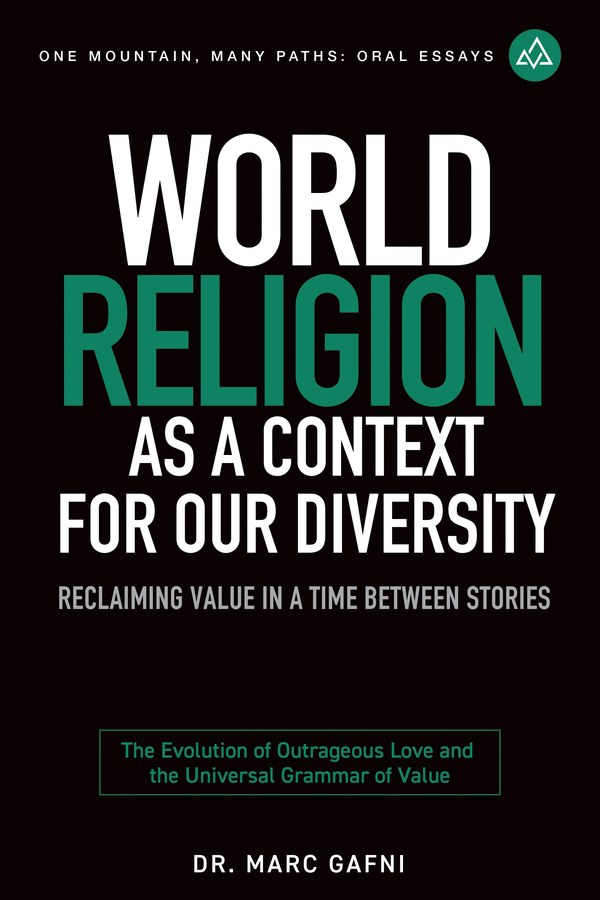
World Religion as a Context for Our Diversity
Volume 17 of the Great Library
The teachings in this essay come from this book.
Get the book →From the oral essays of Dr. Marc Gafni, Volume 17 of the Great Library, World Religion as a Context for Our Diversity (talks from 28 December 2019, 9 February 2020, 12 July 2020 and 25 April 2022). Compiled by Krista Josepha, based on the books and teachings of Dr. Marc Gafni. Updated 11 November 2026.