What makes us human in the age of AI?
On interiority, Unique Self and authentic intelligence, in the words of Dr. Marc Gafni
The passages from Dr. Marc Gafni in this post come from his oral essays in the Great Library: lightly edited transcripts of his live weekly teachings, now called Sensemaking in a Time Between Worlds. The style is spoken word, not a formal essay.
What makes us human is our interiority, and the love that only a person can give. Dr. Marc Gafni teaches that artificial intelligence is not going to have a felt sense of caring and empathy, and that a collective human intelligence in unique self symphony is the only force more intelligent than artificial intelligence.
Can artificial intelligence love?
All of Reality is a love story. The whole thing's a love story, the whole thing. Then the love story becomes conscious at its most crystalline level. There's an evolution of consciousness that's gradual, but there's this momentous leap in consciousness when the love story becomes fully available at the human level.
That love story is about personhood.
It's person-to-person. It's not algorithm to algorithm.
It's person-to-person. It's not broken algorithm to broken algorithm.
It's the two full personhoods meeting.
When two full personhoods meet, it stands against all totalitarian systems, all alien intelligences.
We're not artificial. …
You can't program the core essence of personhood and love. …
Carbon doesn't become silicon. No.
Artificial intelligence does not come alive in that way.
Mr. Zuckerberg, you can't program the core essence of personhood and love. Once you think that, that's the beginning of the death of our humanity. …
Artificial intelligence is not going to enact the prophetic vision.
It's not going to have a felt sense of caring and empathy.
It's not going to have a genuine sense of intimacy.
There is no heart-to-heart.
There's no sense of Homo imago dei, the infinity of value invested in the human being, who is a unique story, which is part of the Universe: a Love Story, which is not ultimately commodifiable and not algorithmically reducible, and not measurable.
Love is about the priceless.
It's about the immeasurable.
It's about all of yesterday, which can be mapped psychologically, and it's about the mystery. It's about the depth of mystery.
And it's about the sacred.
But doesn't an AI that knows me so well really know me?
We can look at the movie Her from ten years earlier by Spike Jonze, after he watched a bunch of chatbots. Theodore falls in love with Samantha, his operating system. This is the emergence of what Eric Schmidt called the next age of AI. Everyone's going to have what rich people have, a personal assistant. …
She knows you based on antecedent causation.
She can predict what you're going to want.
She can respond to your desire.
She can flip back and remember everything that you've ever said before and relate what you're saying based on algorithmic intelligence to something that you previously said.
So, you have this illusory sense that you're being fully known. And in part you are—but ultimately you're not. There's no experience of caring.
What does the tech world think a human being is?
Who am I? The social self narrative is: I'm a social self. The social self might mean, in the religious version, that I'm part of a particular religion, and my entire value comes from my standing within that particular religious or sometimes even national religious structure. So I'm defined by my social context entirely. That's one version of a social self.
But then there's a more insidious version of the social self that actually dominates the internet: the social self, expressed by data science, which upgrades algorithms and downgrades human beings. It says that human beings are the sum total of their measurable actions.
We can get enough data about a human being to predict how they will act given particular stimuli. So the human being becomes a rat in a social maze: nudged and prodded by social stimuli, likes, views, all of the structures of apps, which collect data with their shiny exteriors, promising a few conveniences, but they're actually collecting massive amounts of data that are fed into machine intelligence in order to manipulate your ability to consume or vote—and ultimately influence the government and the economy.
This is in accordance, not with your own interior value—because you're not given enough inward space to discover that—but in accordance with the agendas of whoever has bought the information about you who's now using proven, split-tested methods to manipulate you. That's the social self that's illegitimate. …
Skinner and Pentland both note explicitly: Interiority doesn't matter.
So what makes us human?
Marc answers the idea that a human being is only a social self, to be measured and steered by data:
No, that's not right. We are not only social selves, and nor are we merely separate selves. Rather, in Unique Self, the highest version of social self, my natural, individuated participation in the Field of LoveDesire and the Field of Intimacy is integrated. …
We're part of the same Field of Amor; we're part of the same Field of Desire; we're part of the same Field of Love—which is why Alex Pentland's mathematical equations even work at all. The reason they work is because we are affected by social pressure.
We are social beings, but we're unique social beings.
We're irreducibly unique. We choose and we create, and our interiority is a unique expression of the interior face of the Cosmos.
So we're not merely social selves, and we're not merely separate selves.
What is more intelligent than artificial intelligence?
In an ant colony, ants all know what to do, and they do it on automatic pilot; but that automatic pilot is driven by the secretion of pheromones. Each ant knows what to do, and the ant colony operates. But we need not an ant colony—we need a Unique Self Symphony. Because human beings aren't ants. Human beings can actually choose dystopia or utopia. …
We're confronted by the threat of artificial intelligence outstripping human intelligence, and there's only one gorgeous force that stands against that, an intelligence that outstrips artificial intelligence completely. You know what that is? Unique Self Symphony.
Humans have the capacity to self-organize and create a collective human intelligence that outstrips anything you can possibly imagine. …
We talked about an anthill before. Imagine the image of a swarm intelligence. At the leading edges of science, we now know that a key way to potentiate wisdom—a brilliance and a gorgeousness beyond anything that artificial intelligence can generate—is to move from artificial intelligence to authentic intelligence.
Authentic intelligence means that we gather human beings around the planet and we create a kind of swarm intelligence—but the swarm intelligence is not unconscious, as it is in an anthill or a beehive. Rather, it's a conscious decision by each of us to give our unique gift, guided by the impulse of our uniqueness and the allurement of our uniqueness; the unique configuration of intimacy and desire that wants to move together and move beyond egoic win/lose metrics, and come together as the synergistic Unique Self Symphony. The move to overcome the threat of artificial intelligence is the move from artificial intelligence to authentic intelligence. And authentic intelligence is the intelligence of Evolutionary Love.
Can technology serve our humanity?
We're raising the next generation as "digital natives." They're living inside of the web plex. It has to become not a place of alienation, a place of downgraded humans.
We have to upgrade.
We have to pour Evolutionary Love into the tech plex, into the algorithms. We've got to recode the algorithmic structure of the nervous system of the planet with Evolutionary Love and with these new narratives of identity.
- That is how we respond to existential risk.
- That is how we move from dystopia to utopia, to a joy that's unimaginable, to a freedom and dignity that we can't even begin to dream of.
This happens when human beings come together—both face-to-face and through the "digital intimacy" of the tech platforms—to create Unique Self Symphonies that self-organize and self-actualize Reality to a level of Goodness, Truth, and Beauty, which was the inherent intention of Reality itself.
Something to do today. Put your phone in another room for one hour and spend that hour with a person, face to face. Notice what you know of them that no data could tell you.
Where can you think this through with others?
Every Sunday, Dr. Marc Gafni teaches live and free in Sensemaking in a Time Between Worlds. In the Great Library Book Club we read the books of CosmoErotic Humanism together.
Read also: How to practice Unique Self in everyday life
For Dr. Marc Gafni's critique of the tech plex, see Diagnosing the Techplex: From Digital Dictatorship to Digital Intimacy at the Center for World Philosophy and Religion.
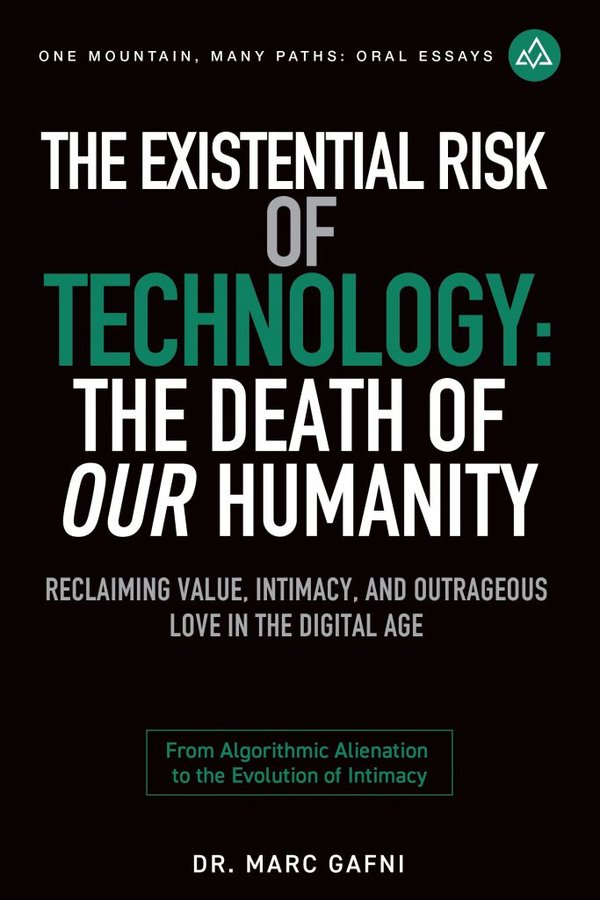
The Existential Risk of Technology: The Death of Our Humanity
Volume 18 of the Great Library
The teachings in this essay come from this book.
Get the book →From the oral essays of Dr. Marc Gafni in the Great Library: Volume 32, Live Your Story: The Categorical Imperative of Reality (talk of 8 December 2024); Volume 18, The Existential Risk of Technology (talks of 24 January and 21 March 2021); and Volume 22, Homo Amor and Unique Self (talk of 28 September 2019). Compiled by Krista Josepha, based on the books and teachings of Dr. Marc Gafni. Updated 11 November 2026.