What is evolutionary prayer?
On a Reality that hears us, and on prayer as protest, in the words of Dr. Marc Gafni and Barbara Marx Hubbard
The passages in this post come from the oral essays of Dr. Marc Gafni and Barbara Marx Hubbard in the Great Library: lightly edited transcripts of their live weekly broadcast, One Mountain, Many Paths. The style is spoken word, not a formal essay.

Evolutionary prayer is the name Dr. Marc Gafni and Barbara Marx Hubbard gave to prayer in their weekly broadcast One Mountain, Many Paths. In his words: "Evolutionary prayer is the ability to know that when we talk, Reality hears us. The personal force in each of us hears each other talk."
What is evolutionary prayer?
We are up-leveling and evolving the consciousness of what it means when we say the word church.
We are up-leveling and evolving the consciousness of what it means when we say God.
Evolutionary Church and evolutionary God.
- God as the personal force.
- God as the impersonal force, animating the evolutionary impulse.
- God as the ceaseless creativity of the Cosmos, birthing ever greater levels of recognition, union, and embrace.
- God that lives in us, as us, and through us, as the irreducible, unique expression of that love and intelligence, which is God.
- God that holds us even as God is us.
In that paradox, have you ever read Rumi? Rumi is always holding that paradox. Rumi is always the friend. Rumi is always aflame with LoveIntelligence, the Divinity of all that is bursting as Rumi, even as Rumi falls into the arms of God at the same time.
One of the great evolutions of consciousness—calling all of us—is the reclaiming of God.
The liberation of the word God from the grasp of fundamentalism to an evolutionary God, where we actually experience the personal force of Cosmos that lives in us, holding us, is essential.
Feel into that possibility. Feel into this notion of evolutionary prayer. What is evolutionary prayer?
Evolutionary prayer is the ability to know that when we talk, Reality hears us. The personal force in each of us hears each other talk. When we talk, Reality hears us.
So, our speech is a prayer. It's not just that we hear each other, but the intelligence that lives in each of us, the personal intelligence, which is our uniqueness of Cosmos, participates in the larger LoveIntelligence of Reality that hears our words, that holds us.
We realize every time we fall, we fall into God's hands. Every time we fall, we fall into the LoveIntelligence of Reality that intended my existence.
And that is what we mean by evolutionary prayer.
How is it different from the prayer I grew up with?
- We are seeking to participate together in the very evolution of what prayer means.
- We are not talking about the old vision of prayer.
- We are talking about evolutionary prayer.
We are talking about the evolutionary God in which we both bow and participate together in the very evolution of God. We are pouring new evolutionary wine into old flasks, which is the way of evolution itself. …
Prayer now means something greater, larger, deeper.
What is the experience of prayer? The experience of prayer is knowing:
- That Reality hears us.
- That when we speak, Reality—which is sometimes called God by the mystics (God and Reality are the same)—All-That-Is hears.
- Our words are not spoken into a vacuum.
This is a pointing-out instruction.
The phrase, pointing-out instruction, we borrowed from our Tibetan Buddhist friends. A pointing-out instruction means we point to something that we already know. What do we already know?
For instance, we already know that we can hear each other talk. Not just through the physical structure of the ear but we can actually hear through the intelligence that animates our uniqueness. And, we each participate in the larger intelligence of Cosmos. We are each a part of the loving intelligence of Reality.
Can prayer be a protest?
I now want to talk about prayer as protest. Protest happens in many ways. Protest happens through humor, through laughter, and protest happens through demand. But there's a revolution in prayer. When we're protesting, there's a protest that challenges Divinity.
We don't only come to prayer as supplicants asking, pleading. In the interior sciences, prayer itself is a form of protest. …
In the great traditions, there were two forms of protest where I challenge God. I challenge God as part of the revolution. I both partner with the Divine—I'm Divinity's evolutionary partner—and I'm protesting. So I partner and protest at the same time.
Isn't it disrespectful to argue with God?
Marc answers with a story from the Hebrew lineage:
It's Yom Kippur eve, and everyone's gathered at the prayer hall of the great Hasidic master named Levi Yitzchok of Berditchev. …
So Levi Yitzchok of Berditchev is at the prayer hall. It's packed. Everyone's there in full joy. They're there ready to offer up their prayers.
In the middle of all this, in walks this man who everyone knows never comes to the prayer hall. He pushes his way through, goes to the front, stands by the holy ark. Then he grabs the curtain and mumbles a few sentences. Then he says, I'm done. Let me know if we have a deal, and then just walks out. Everyone wants to grab him. They're utterly furious with him. …
Twenty-five hours later, at the end of the holy day, the great master Levi Yitzchok of Berditchev says, Get me that man. I desperately need to talk to him. Everyone is like, Why does he want to talk to this arrogant man who came in and violated the sanctity of the day? But they go and find him, and they bring him before Levi Yitzchok. Friends, open your hearts. Let's open our hearts together. Levi Yitzchok says to this man, You've got to be my teacher. I have never seen anyone pray with the confidence that you prayed. You must tell me your prayer. Wow.
The man says to Levi Yitzchok, I'll tell you my prayer. It's very simple. I said to God, "God, you know, I've made some mistakes this year. There were a couple of weights and measures I didn't do exactly right, and there were times I got angry that I shouldn't have, and I got a little contracted, and I'm sorry for that. And I didn't always get to fulfill all of the rituals. There are times I should have been a tad sweeter. God, I want your forgiveness, but, God, you've had a terrible year. The woman who lives two doors down from me, her husband died in the middle of the night, and she's left with four children. Two blocks over, there's the woman who lives by herself with three children, and one of them is sick. She can barely put food on the table, and she's wracked with anxiety every day." This man went through the entire list of people suffering intensely in Berditchev. Finally, he says, God, you've had a terrible year, but you know what? I'm willing to work with you. Let's make a deal. You forgive me, and I'll forgive you. Do we have a deal? And then he walked out. Wow!
Levi Yitzchok looks in his eyes and says, Never has a more holy prayer ever been prayed, but, my friend, he says with tears in his eyes, you made only one mistake. You prayed only for yourself and not for the whole world. Had you prayed for the whole world, the whole world would have been instantly liberated in one moment.
Can you hear that, friends? That's prayer as protest. That's demanding something from God. Prayer as protest—and it's a complete paradox.
What do you say when you pray as protest?
In the intimacy of prayer there's protest. In genuine intimacy there must be protest.
No, God, it can't be this way.
God, we're so intimate.
God, I love you so madly I can't allow for this pandemic.
God, you've got to heal it.
God, you've got to fix it.
And, yes, God, we're going to be revolutionaries.
And, yes, we're going to be activists.
And, yes, we're going to evolve the source code.
And, yes, we're going to articulate the new First Principles, but you've got to be there with us—we demand your presence.
We demand that you hold our hands.
We demand that you heal the world.
We demand that you partner with us.
We can't do it without you, and you can't do it without us.
What if God stays silent?
Of course, in that moment of the void, we know that the silence is a Silence of Presence. We know that as we scream those words, Divinity is speaking through us—and God is more present in the apparent absence than He/She/It, the Infinity of Intimacy, ever was.
It's not a silence of absence. It's a Silence of Presence.
The voice of protest is the voice of the Divine speaking through us. Evil is a failure of intimacy, and it's only when we restore the intimacy in the act of protest that we can be revolutionaries. So we're not revolutionaries in the Marxist sense, where we're stepping away from the Divine. We're revolutionaries in this new sense in which our lives are a protest.
We offer our lives as protest, prayer as protest, prayer as holy audacity, prayer as: "God, let's make a deal—and, God, this is a deal you can't refuse, because we need you, you need us, and the time is now. Ad matai? Until when? It's got to end now." We protest.
You know what Divinity does when we protest? Smiles. God laughs.
Something to do today. Choose one person whose suffering you cannot accept, and say their name out loud to God as a demand. Then name what you will do yourself, as Divinity's partner.
Where can you pray with others?
In Prayer as Protest, Dr. Marc Gafni leads live Evolutionary Prayer twice a week inside Who We Must Become. Every Sunday he also teaches live and free in Sensemaking in a Time Between Worlds.
Read also: Is there a church without dogma?
For the God who hears prayer, see Daily Wisdom: God in second person is all about relationship at the Center for World Philosophy and Religion.
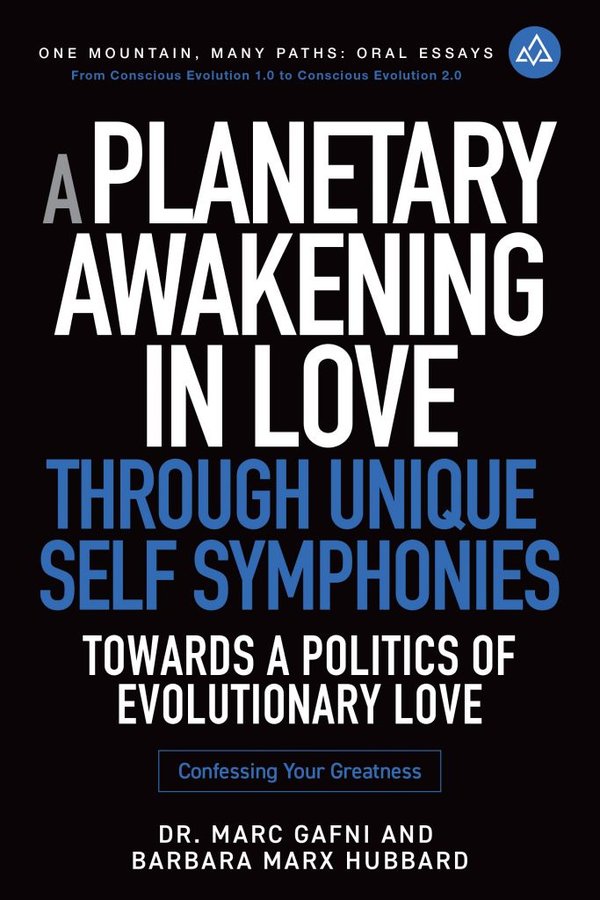
A Planetary Awakening in Love Through Unique Self Symphonies
Volume 1 of the Great Library, by Dr. Marc Gafni and Barbara Marx Hubbard
The teachings in this essay come from this book.
Get the book →From the oral essays of Dr. Marc Gafni in the Great Library: Volume 1, A Planetary Awakening in Love Through Unique Self Symphonies, with Barbara Marx Hubbard (talks of 5 and 12 November 2016), and Volume 17, World Religion as a Context for Our Diversity (talk of 30 August 2020). Compiled by Krista Josepha, based on the books and teachings of Dr. Marc Gafni and Barbara Marx Hubbard. Updated 11 November 2026.